Modern buildings are becoming more connected, more intelligent and considerably more data-driven.
Lighting is no longer simply a collection of fittings switched on and off from the wall. It can be part of a wider building ecosystem – responding to occupancy, sharing real-time data with other building services, monitoring energy use and giving facility teams a clearer picture of how their spaces are performing.
But for all of that to work effectively, what happens behind the scenes matters.
The architecture supporting a lighting control system determines how quickly it responds, how easily it can expand, how well it integrates with other systems and, importantly, what happens when something goes wrong.
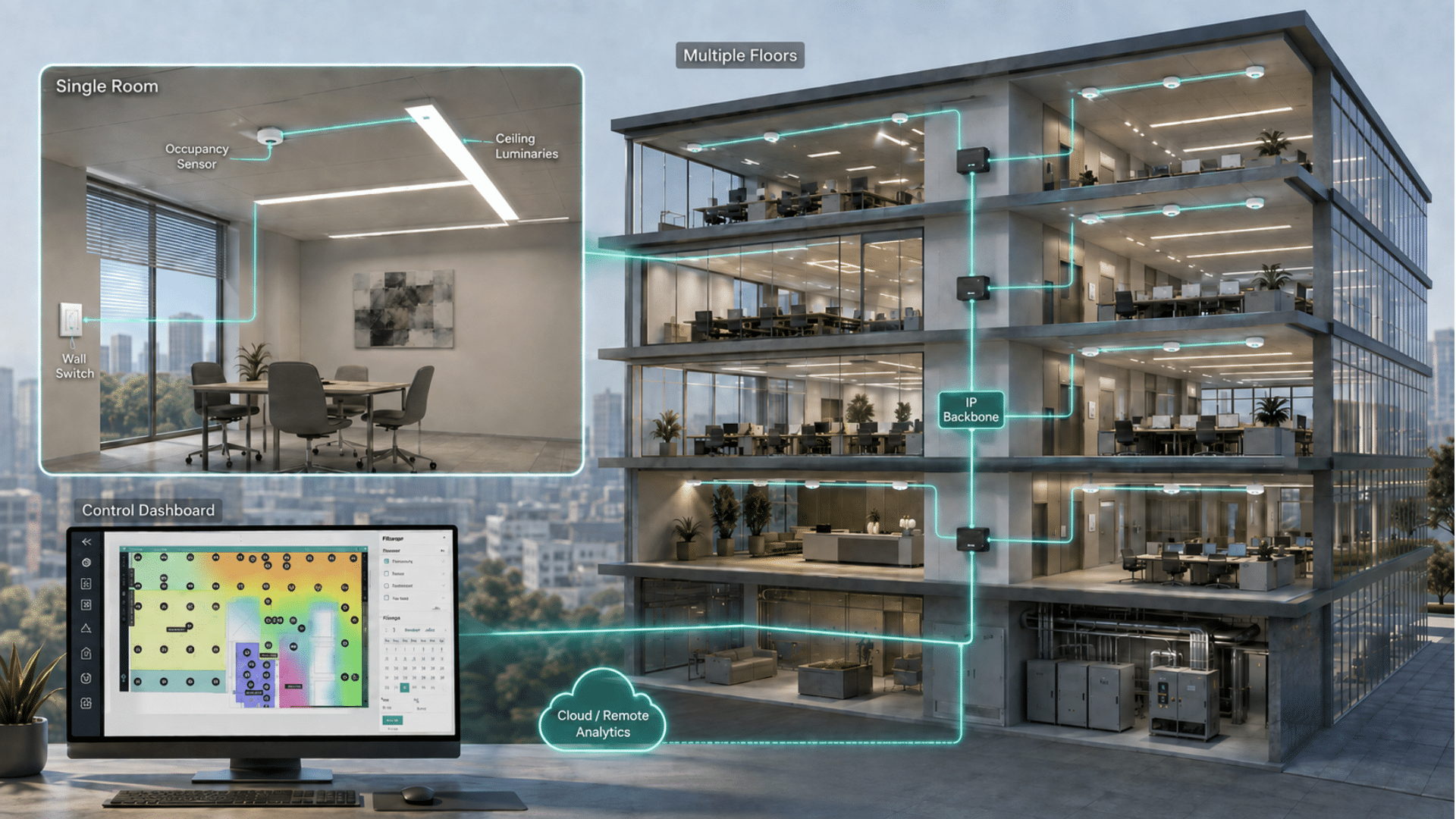
zencontrol has been designed around a distributed, IP-based architecture that can start with a single room and scale through an entire building, multi-site portfolio or even locations around the world.
Here’s how it works – and why it matters.
Intelligence Without a Single Point of Control
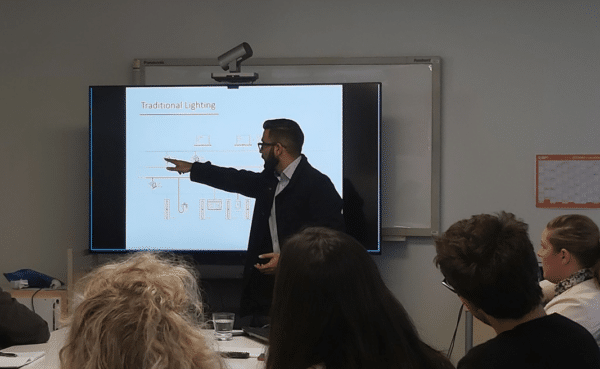
Traditional control systems can depend heavily on a central processor. If everything has to report back to one central point before an action can happen, that processor becomes rather important.
zencontrol takes a different approach.
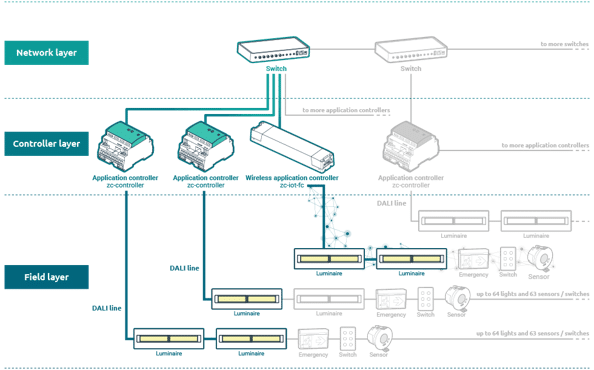
Its distributed, multi-master architecture allows switches, sensors and controllers to communicate directly. Devices share their status with each other across the network, keeping lighting states and indicator LEDs synchronised while allowing commands to be processed quickly.
Switches and sensors communicate with their application controller over DALI, while the controllers themselves communicate over Ethernet.
The result is a system where a switch can control luminaires elsewhere on the network, while real-time data is shared across multiple DALI lines and throughout the wider system.
More importantly, there isn’t one central component holding everything together.
If an individual controller or DALI line becomes isolated, the rest of the system can continue operating. For building owners and facility teams, that distributed intelligence creates greater resilience and removes a significant single point of failure.
Start With One Room. Keep Going.
One of the biggest challenges with building technology is designing for what the building might need tomorrow – not simply what it needs on handover day.
zencontrol is inherently scalable.
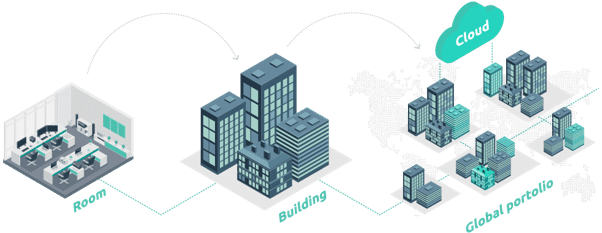
A smart device can operate independently, as part of a small group or within a larger system managed by DALI-2 application controllers. Each application controller can manage up to 64 DALI devices per line, along with up to 64 sets of DALI control devices, including multi-channel inputs such as switch plates.
Connect those controllers using Ethernet and the lighting system begins to form a high-speed IP backbone across the building.
Need another floor? Add more controllers.
Extending the fit-out? Expand the network.
Adding another building? The same architecture can continue to grow without requiring the whole system to be redesigned.
Because the backbone is IP-based, the concept can extend beyond individual floors and buildings to campuses, multiple sites and international portfolios.
The zencontrol cloud brings data from across these systems together, processing millions of datapoints to provide near real-time visibility into building performance.
And this is not scalability that exists only on a specification sheet.
zencontrol has delivered BACnet installations exceeding 300,000 points at individual sites, with major deployments surpassing 1.2 million points. Projects using the technology range from buildings with more than 10,000 DALI drivers to large residential developments containing upwards of 50,000 devices.
Closer to home, 83 Pirie Street in Adelaide demonstrates the system at scale, with approximately 8,000 DALI-2 light fittings monitored through the zencontrol cloud across 22 floors. The project uses occupancy detection, heat mapping and cloud-based management to help optimise energy use and occupant comfort.
Whether it is one room or tens of thousands of devices, the fundamental architecture remains the same.
Built on Networks Buildings Already Understand
Another important part of the zencontrol architecture is what it doesn’t require: an entirely proprietary communications network.
Every zencontrol application controller connects directly to Ethernet.
Using standard IP infrastructure makes it easier to expand lighting control across floors, buildings and sites while reducing the need for specialised network cabling.
It also creates a common platform for integration with other technologies.
zencontrol supports protocols and services including:
- BACnet
- DALI-2
- MQTT
- DMX
- Control4
- third-party building services
Controllers can operate as native BACnet servers and support BBMD and foreign device functionality, enabling BACnet traffic to move between network subnets without requiring additional gateways.
For consultants and integrators, that makes lighting significantly easier to incorporate into the wider building services strategy.
Rather than the lighting system sitting in its own little technological island, it can become part of the building’s broader digital infrastructure.
Connecting Lighting With the Wider Building
Once lighting becomes part of the IP network, the opportunity extends well beyond switching lights.
Building management systems, HVAC, security, audiovisual technology and other services increasingly need to communicate and share data across the building.
zencontrol’s open architecture provides a pathway for that integration.
A head-end server can operate locally across the building’s Ethernet network, while the zencontrol cloud uses the same infrastructure to deliver remote dashboards, system analytics and energy monitoring.
Additional capabilities and licences – including BACnet connectivity and analytics functionality – can also be deployed remotely without needing to install new hardware onsite.
That is particularly useful in buildings that continue to evolve after practical completion.
Instead of treating commissioning as the end of the lighting control journey, functionality can continue to develop alongside the building.
Turning a Large Building Into Something Manageable
Technically, a building may be one site. Operationally, it rarely behaves like one.
There are floors, rooms, tenancies, departments, shared spaces and restricted areas – each potentially requiring different schedules, controls and levels of access.
zencontrol allows systems to be organised around the way the building actually operates.
Within the cloud platform, projects can be structured into individual floors, tenancies and device groups. Using Plan View, floorplans can be uploaded and devices positioned visually within rooms and zones.
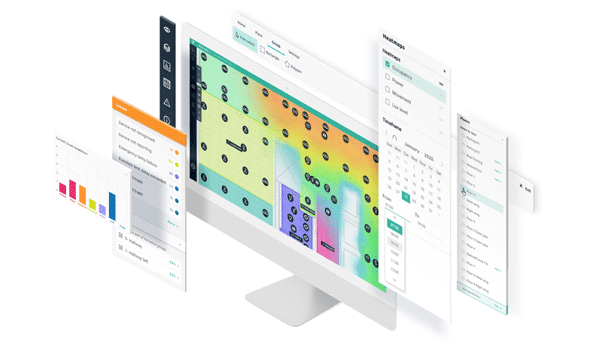
Instead of searching through endless device numbers, facility teams can see where equipment is located and review details such as device IDs, groups, operational status and control parameters directly from the building plan.
That makes a complex lighting network considerably easier to understand.
From Building Controls to Building Intelligence
Knowing where devices are is useful.
Knowing what they are doing is even better.
Plan View can display live occupancy and power heatmaps using data collected from devices throughout the building.
Occupancy, energy consumption and fault data can therefore become visible within the context of the actual floorplan.
Facility teams might identify an area consuming significantly more power than expected, see how occupancy patterns change during the day or quickly locate equipment reporting a fault.
Over time, that data can support more informed decisions around scheduling, energy efficiency and how spaces are being used.
In other words, the lighting control network becomes more than something that operates the lights.
It becomes another source of building intelligence.
The Right Access for the Right People
Connected buildings also introduce another question:
Who should be allowed to control what?
A facility manager requires very different access from an office tenant. An electrical contractor commissioning a fit-out needs different permissions again.
Giving everybody administrator access is certainly simple.
It is probably not a particularly good idea.
zencontrol provides granular permissions that allow access to be assigned according to both a person’s role and the areas of the building they need to manage.
Different account types cater for different users. Integrator accounts provide comprehensive access to system functionality, Manager accounts can access tools such as Plan View, schedules and emergency reports, while Personal accounts are designed for everyday users controlling lighting or connected services.
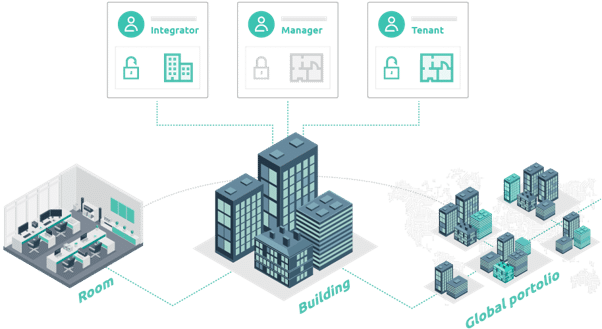
Site owners retain administrative control and can add additional owners, site members or tenancy members.
Permissions can then become highly specific.
A tenant might be allowed to control lighting and blinds only within their leased floor.
A facilities manager could have visibility across lighting, HVAC and emergency systems throughout the property.
A contractor working on a new tenancy could be granted temporary access to the relevant control system, then have that permission removed once commissioning is complete.
Administrators can also audit activity, revoke access and roll back unwanted changes through the cloud portal.
It is a small detail until you are managing hundreds of users across a large building. Then it becomes a very big detail.
Why Architecture Matters
Much of a lighting control system is invisible once a building is completed.
Occupants see switches, sensors and luminaires.
Behind them sits the network responsible for making everything respond.
That underlying architecture can determine whether a system is flexible or restrictive, resilient or dependent, isolated or capable of becoming part of the wider smart-building environment.
zencontrol’s architecture has been designed around several important principles:
Distributed intelligence
Removing dependence on a single central processor creates a more resilient system and allows sections of the network to continue operating independently.
Scalability
A project can begin with a room and expand through floors, buildings and entire portfolios without fundamentally changing the architecture.
Open integration
Support for protocols including BACnet, DALI-2, MQTT, DMX and Control4 allows lighting to communicate with other building services.
IP connectivity
Standard Ethernet infrastructure provides a familiar and scalable backbone for both local and cloud-based control.
Better visibility
Plan View, energy data, occupancy data and fault monitoring give facility teams a clearer understanding of what is happening throughout the building.
Controlled access
Granular user permissions make it possible to give people the control they need — without giving them control over everything else.
Designing for What Comes Next
Buildings rarely remain exactly as they were on opening day.
Tenants change. Floors are reconfigured. Technology evolves. New services are integrated. Expectations around energy performance and building data continue to increase.
The value of a well-designed control architecture is its ability to accommodate that change.
By combining distributed intelligence, DALI-2 control, Ethernet connectivity, open protocols and cloud-based management, zencontrol provides an architecture capable of growing alongside the buildings it controls.
Because the smartest building technology shouldn’t simply work well today.
It should make whatever comes next easier too.
Want to learn what intelligent lighting control could look like for your building?
Talk to the Intelligent Environments team about designing a scalable lighting control solution that integrates with your wider building environment and gives you greater visibility, flexibility and control.