
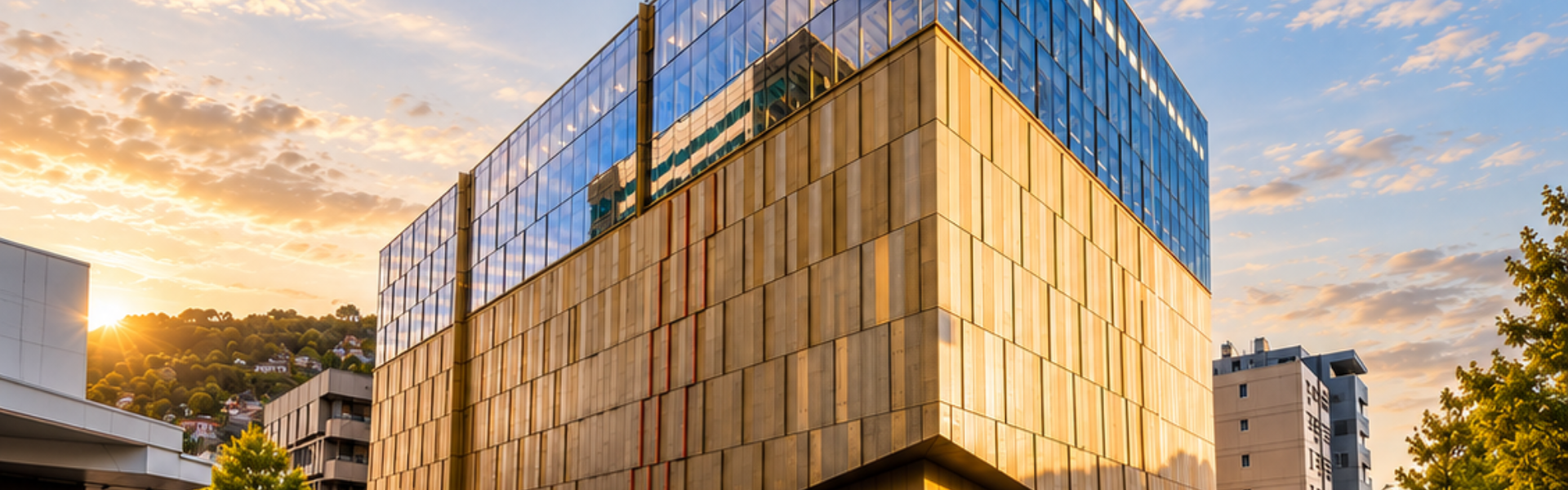
CASE STUDY
Te Rua Archives
Location: Wellington, New Zealand
Advanced DALI-2 lighting control supporting preservation, operational efficiency and long-term resilience
PROJECT PARTNERS
- Client: Department of Internal Affairs
- Sector: Government & Public Infrastructure
- Engineer: NDY
- Builder: Dexus
- Electrical Contractor: NME
- Lighting Control System: zencontrol
- Lighting Control Integrator: Intelligent Environments
Overview
Te Rua Archives New Zealand is a highly specialised archival facility designed to protect, preserve and provide access to some of New Zealand’s most important records and taonga.
The building includes public areas, collection floors, conservation and digitisation spaces, studios, offices and specialist work environments – each with very different lighting requirements.
Intelligent Environments was engaged as the zencontrol integrator, delivering a fully programmable DALI-2 lighting control system integrated with the Building Management System through BACnet IP.
The result is a lighting environment designed around preservation, visual accuracy, energy efficiency and long-term flexibility.
Objectives
The lighting control system needed to achieve more than simple on/off control.
It was designed to:
- Protect sensitive archival materials by limiting unnecessary light exposure.
- Provide accurate colour rendering for conservation and digitisation work.
- Give specialist teams precise control over light levels and colour temperature.
- Reduce energy use through occupancy sensing, daylight control and scheduling.
- Allow facilities teams to monitor, adjust and maintain the system remotely.
- Provide a flexible platform that could adapt as the building’s requirements change.
Technical Challenges & Solutions
Different spaces required different lighting conditions
A collection store has very different requirements from an office, conservation laboratory or photo studio.
The solution was to create individual control strategies for each environment rather than applying one standard approach across the building.
Collection areas use occupancy sensing and timed control to minimise unnecessary light exposure, while offices and public areas combine scheduling, daylight sensing and after-hours occupancy control.
Specialist work required precise colour and light control
Conservation and digitisation teams need lighting that allows materials, colours and details to be assessed accurately.
Tuneable white lighting provides a colour temperature range of 2700K to 6500K, supported by dimming, preset scenes and high colour-rendering lighting.
Portable task lights within preservation and conservation areas provide CRI 95+ performance and up to 1600 lux where detailed work is required.
Access to some areas is controlled
Regular access to collection and environmentally controlled spaces can be restricted.
Through zencontrol, facilities teams can remotely monitor the lighting network, identify faults, adjust settings and carry out reprogramming without needing to enter every space.
Energy use had to be carefully managed
Lighting is automatically controlled using occupancy sensing, daylight sensing and time-based schedules.
Where manual control is required, timed overrides ensure lights do not remain on indefinitely.
External and landscape lighting is also scheduled and dimmed to meet operational and Green Star requirements.
System Design & Application
The DALI-2 system controls lighting across the majority of Te Rua and combines:
- DALI dimming
- Tuneable white lighting
- Occupancy sensing
- Daylight sensing
- Time-based scheduling
- Preset lighting scenes
- Local user controls
- BACnet IP integration
- Remote monitoring and diagnostics
- Remote reprogramming
Control strategies are then tailored to each part of the building.
Public and office areas operate primarily on scheduled control, with occupancy sensing after hours and daylight control around perimeter zones.
Collections floors use occupancy-controlled corridors and manually activated shelving lighting, with automatic time-outs to reduce unnecessary exposure.
Conservation and digitisation spaces use tuneable white lighting, dimming and preset scenes to support detailed specialist work.
Photo and AV studios use dimmable, flicker-free lighting with local workstation control.
Even the Box Making Room uses tuneable white lighting programmed around a circadian cycle to create changing daylight conditions throughout the day.
Why DALI-2 and zencontrol?
For a building such as Te Rua, lighting requirements are too varied and specialised for a simple fixed-control system.
DALI-2 provides the flexibility to control individual luminaires and groups, create different lighting scenes and adjust programming as operational requirements change.
Combined with zencontrol, the system also gives facilities teams greater visibility over the lighting network.
They can monitor performance, identify faults, adjust schedules and refine the system remotely.
This is particularly valuable for Te Rua, where controlled access, preservation conditions and long-term building performance are important considerations.
Rather than being fixed at commissioning, the lighting system can continue to evolve with the facility.
Project Impact
Te Rua demonstrates how intelligent lighting control can support both the preservation of irreplaceable collections and the people responsible for them.
The completed system provides:
- Precise lighting for specialist archival work
- Reduced unnecessary light exposure within collection areas
- High-quality colour rendering for conservation and digitisation
- Automated energy-saving control
- Remote monitoring and fault diagnostics
- Integration with the wider Building Management System
- Greater flexibility for future changes and recommissioning
Lighting also supports the wider architectural and cultural intent of Te Rua, with iwi narratives, ceremonial spaces, public areas and the building façade considered as part of the overall lighting design.
For Intelligent Environments, the project demonstrates the value of a properly designed DALI-2 control system in an environment where precision, preservation, resilience and long-term adaptability are essential.
To learn more about this project or discuss how Intelligent Environments can support your lighting control requirements, contact our team for advice and a no-obligation quote.