
Urban environments are evolving rapidly. Cities are densifying, public expectations are rising, sustainability targets are tightening, and communities increasingly value spaces that feel safe, adaptable, and welcoming.
Whether it’s a civic square, a neighbourhood park, a coastal walkway, or an immersive exhibition like the tropical ecosystems at Auckland Zoo, lighting plays a foundational role in how people experience and value public places.
Today, the conversation is no longer just about lighting. It’s about lighting control.
Smart, responsive lighting control systems have become a critical layer of infrastructure across community spaces, transport hubs, cultural assets, conservation environments, and public-realm projects. For councils, developers, architects, engineers, and facility managers, lighting control is now integral to financial efficiency, sustainability performance, visitor wellbeing, and long-term operational capability.
As a specialist lighting control integrator and design partner, Intelligent Environments sees every day how good lighting enhances a space and how intelligent control systems allow that lighting to work harder, last longer, and deliver more value across the entire lifecycle of a project.
From civic plazas like Te Rimutahi in Ponsonby to ecologically sensitive environments like Auckland Zoo’s Swamp Ecosystem, the benefits extend far beyond illumination.
This article explores why lighting control has become essential infrastructure in modern public environments, how it enhances wellbeing and safety, and why forward-thinking organisations are adopting intelligent systems as a strategic investment – not a technical add-on.
Understanding Public & Urban Spaces as Complex Environments
Public spaces are no longer single-purpose assets. They increasingly serve multiple roles for multiple audiences at multiple times of day. A civic plaza may function as a commuter thoroughfare in the morning, a community gathering point in the afternoon, an event venue at night, and a destination for families on weekends.
Urban designers and councils also recognise the social importance of these spaces. They must be accessible, safe, inclusive, environmentally responsible, and culturally meaningful. Lighting is fundamental to achieving these objectives but traditional lighting strategies no longer meet contemporary expectations.
Public spaces now require lighting systems that can:
- adapt to changing daylight conditions
- respond dynamically to how the space is being used
- support safety without unnecessary energy waste
- integrate with wayfinding, architectural design, and urban placemaking
- reduce operational expenditure and maintenance intensity
- support long-term sustainability and carbon reduction goals
This is where intelligent lighting control becomes a strategic asset.
Why Lighting Control Matters: Performance, People, and Financial Outcomes
- Lighting Control Supports Safety, Visibility, and Public Confidence
People feel safer in well-lit environments but “more light” is not always the answer. The key is appropriate light, at the right time, in the right zones. Over-illumination can cause glare, reduce visibility, increase energy usage, and create visual discomfort.
With intelligent lighting control, illumination levels can be gradually increased as natural daylight fades, adjusted automatically during adverse weather, and zoned so high-use areas receive the right lighting while peripheral areas can dim.
This enhances:
- perceived safety for pedestrians, families, and evening users
- actual visibility in areas where risk or activity is higher
- social activation, encouraging community use and engagement
- asset protection, reducing vandalism or unwanted activity
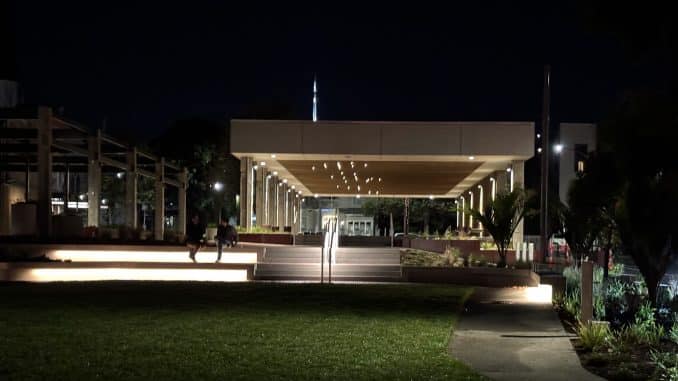
Te Rimutahi in Ponsonby is a strong example of this principle. The site includes architectural lighting, handrail LEDs, bollards, pole lights, and ambient canopy lighting – all operating cohesively through a multi-zone zencontrol system. Automated daylight-responsive control ensures the lighting subtly shifts as the environment changes, supporting both safety and atmosphere without any manual intervention.
- Enhancing Wellbeing and User Experience
Light affects human wellbeing far more profoundly than most people realise. It influences mood, orientation, comfort, and even circadian rhythms. In public settings where users of all ages, abilities, and cultural backgrounds come together – thoughtful lighting control can improve the overall experience of a space.
Intelligent lighting systems enhance wellbeing by:
- reducing harsh contrasts or glare
- ensuring consistent illumination across pathways and civic areas
- creating ambience appropriate to the space’s function
- supporting inclusivity for visually impaired users
- enabling smooth transitions that feel natural, not abrupt
In immersive environments like Auckland Zoo’s Swamp Ecosystem, lighting also plays an ecological and educational role. The zencontrol DALI system installed there replicates natural sunrise and sunset transitions with precision, supporting the circadian rhythms of plants and animals within the dome. Five lux sensors constantly monitor light levels, adjusting output to create a stable, biologically accurate environment – even as external daylight conditions fluctuate.
This is lighting control not just as infrastructure, but as part of the wellbeing and welfare strategy for living ecosystems.
- Financial and Operational Efficiency for Asset Owners
Across councils, developers, and facility portfolios, lighting often represents one of the largest operational line items in public spaces. Intelligent control systems unlock significant efficiencies, including:
- reduced energy usage through daylight harvesting and adaptive dimming
- extended luminaire lifespan by preventing over-illumination
- lower maintenance costs through real-time monitoring and fault detection
- scheduled scenes that avoid unnecessary operation
- remote access and diagnostics, reducing site visits
When Intelligent Environments implemented automated daylight control at Te Rimutahi, the system began adjusting output based on natural conditions from day one, optimising energy usage without compromising visibility or user comfort. For asset owners, these automation layers provide immediate and long-term financial reward.
In more complex environments like the Auckland Zoo, where humidity, temperature, and lighting all interplay, integration with the Building Management System (BMS) provides centralised oversight. This reduces operational overhead while ensuring environmental consistency.
Lighting control, when implemented strategically, becomes a measurable contributor to sustainability reporting and cost-to-serve reduction.
- Supporting Sustainability and Meeting Council Environmental Obligations
Many public-sector organisations now operate under ambitious sustainability frameworks. Carbon reduction, Green Star certifications, NABERSNZ, and long-term environmental performance targets are becoming standard requirements.
Lighting control systems directly support:
- efficient energy consumption
- reduced carbon emissions
- less environmental spill light (important in parks, reserves, and coastal areas)
- compliance with local authority environmental priorities
- data-driven reporting, via energy and system performance analytics
By integrating daylight sensors, occupancy modes, and timeclock scheduling, lighting becomes responsive rather than static – dramatically reducing unnecessary usage.
At Te Rimutahi, the control strategy was developed to align with Auckland Council’s environmental commitments. At the Auckland Zoo, lux-optimised control supports sustainability while maintaining the health of the ecosystem.
Sustainability is now both a moral and financial imperative. Lighting control contributes meaningfully to both.
- Supporting Dark Sky Principles and Minimising Light Pollution
As urban areas intensify, light pollution has become a growing environmental and social concern. Excessive or poorly controlled artificial light can disrupt ecosystems, affect human sleep patterns, obscure night skies, and spill unnecessarily into neighbouring residential areas, waterways, and natural habitats. Increasingly, councils and public-sector asset owners are being asked to balance safety and amenity with responsible night-time lighting practices.
Lighting control systems play a critical role in achieving this balance and supporting dark sky principles without compromising functionality or public safety.
Intelligent lighting control enables public spaces to deliver light only where and when it is needed, reducing unnecessary sky glow and light spill. Through precise zoning, dimming, and scheduling, luminaires can operate at appropriate levels for pedestrian safety while avoiding blanket illumination that contributes to light pollution.
Key strategies include:
- Time-based dimming and curfews, reducing light output during late-night low-use periods
- Zoned control, ensuring peripheral or environmentally sensitive areas are dimmed or switched off when not required
- Daylight-responsive control, preventing artificial lighting from operating when natural light is sufficient
- Scene-based operation, allowing lighting levels to adjust for events while returning to low-impact settings afterwards
- Targeted illumination, ensuring light is directed to paths and activity zones rather than spilling upward or outward
In environments adjacent to parks, coastlines, waterways, or residential neighbourhoods, these controls significantly reduce ecological disruption and visual intrusion. This is particularly important for wildlife-sensitive areas, where artificial light can interfere with natural behaviours such as migration, feeding, and breeding.
Projects such as Te Rimutahi demonstrate how a well-considered control strategy allows a civic space to remain safe, welcoming, and visually engaging, while avoiding over-illumination. Lighting levels transition naturally from day to night, respond to real-world conditions, and remain proportionate to how the space is actually being used.
For councils and developers, supporting dark sky principles through lighting control is increasingly aligned with:
- environmental stewardship and biodiversity protection
- community expectations around responsible urban development
- planning and consent conditions
- long-term sustainability frameworks and climate strategies
- reputational leadership in placemaking and public realm design
Importantly, these outcomes are achieved through control, not compromise. Intelligent systems allow public spaces to remain functional and activated, while significantly reducing their night-time environmental footprint.
- Supporting Placemaking, Cultural Expression, and Community Use
Public spaces today are designed not only for function but for identity. Lighting is increasingly part of the storytelling and cultural expression within a space, highlighting architectural features, enhancing artwork, supporting activation events, and reinforcing a site’s character.
Without intelligent control, lighting environments become static, limiting how the site evolves over time.
With modern control systems, spaces can:
- shift scenes for seasonal events, community festivals, or cultural celebrations
- support curated lighting for performances or local art installations
- adapt for low-key evenings versus high-activity weekends
- maintain ambience without compromise, regardless of the hour
In the Ponsonby Civic Centre project, integrated uplighting, handrail LEDs, canopy lighting, and pole lights work together across various modes – everyday use, community gatherings, special events. The technology remains invisible, allowing the space itself to take centre stage.
Lighting control is, in many ways, the enabler of urban placemaking.
What Organisations Gain When Lighting Control is Considered Early
The most successful lighting control outcomes occur when integrators are involved early in the design process. Early engagement allows better alignment between architectural intent, engineering requirements, and operational needs.
This reduces risk, prevents redesign costs, and ensures systems are scalable for future changes. Councils, for example, often need lighting that supports not just today’s usage, but new forms of activation as communities evolve.
Engaging Intelligent Environments early ensures:
- fewer design conflicts
- optimised luminaire specifications
- easier coordination with electrical contractors
- seamless BMS integration
- fewer variations during construction
- reduced project delivery risk
- a system that performs as intended – quietly, reliably, long-term
Lighting control should never be an afterthought. It is an integral part of the planning and procurement strategy for modern public environments.
Examples of Intelligent Control in Action (Brief Highlights)
Te Rimutahi, Ponsonby Civic Centre
A multi-zone zencontrol system supports architectural and amenity lighting across a highly activated civic space. Automated daylight harvesting and scheduled scenes ensure energy efficiency, safety, and ambience throughout the day and night.
Auckland Zoo – Swamp Ecosystem
An intelligent DALI control platform replicates the natural tropical light cycle with precision. Lux sensors maintain environmental stability, supporting plant health and animal welfare. Integration with the BMS provides unified environmental management.
Both projects demonstrate how lighting control extends beyond illumination – it becomes part of the user experience, operational strategy, and long-term value of public assets.
Lighting Control as Strategic Infrastructure for Modern Cities
As Auckland and other New Zealand urban centres continue to grow, expectations around public spaces will only rise. Communities want places that feel safe, intuitive, vibrant, and environmentally responsible. Councils and developers want assets that perform efficiently, reliably, and economically.
Intelligent lighting control intersects all these priorities. It transforms static lighting into adaptive infrastructure. It enables better financial performance. It enhances wellbeing and user comfort. It supports sustainability. And it brings design intent to life with precision and flexibility.
Public spaces will continue to evolve – and lighting control will increasingly become one of the foundational components shaping how those spaces operate and how people experience them.
Plan Your Next Public Space or Urban Lighting Project With Confidence
If you’re planning a civic space, community asset, zoo or conservation environment, public-realm project, or any infrastructure upgrade that demands smart, adaptive lighting, our team can help.
Intelligent Environments provides:
- Early-stage design support
- Control system integration
- Daylight and lux-responsive strategies
- Multi-zone and event-ready configurations
- BMS integration
- Ongoing maintenance, monitoring & optimisation
- NZ-wide consultation and project support
To discuss your next project or arrange a free consultation anywhere in New Zealand, get in touch with the Intelligent Environments team.