In 2026, commercial lighting control has moved well beyond efficiency alone. While energy performance remains important, the focus has shifted toward how lighting actively supports human wellbeing, comfort, and performance within buildings.
As organisations place greater emphasis on healthier workplaces and future-ready assets, lighting is increasingly recognised as a critical environmental factor – one that influences biological rhythms, cognitive function, and visual comfort throughout the working day. This shift has accelerated the adoption of human-centric and wellness-driven lighting strategies, supported by intelligent, adaptive control systems.
From Visibility to Wellbeing
Traditional lighting design prioritised visibility and compliance. Today, it is widely understood that light also affects the human circadian system – the internal clock that regulates alertness, mood, sleep quality, and overall wellbeing.
When indoor lighting is poorly aligned with natural daylight cycles, occupants may experience fatigue, reduced concentration, and long-term health impacts. In contrast, lighting that adapts throughout the day to reflect natural light patterns can support:
- Improved alertness and cognitive performance
- Reduced eye strain and visual discomfort
- Better mood stability and occupant satisfaction
Frameworks such as the WELL Building Standard have helped formalise this understanding, encouraging building owners and designers to consider lighting as a contributor to human health – not just a technical service.
The Role of Tunable White Lighting
Central to human-centric lighting is tunable white technology, which allows both light intensity and colour temperature to be adjusted dynamically across the day.
Rather than emitting static white light, tunable systems can follow a natural progression:
- Brighter, cooler light in the morning to support focus and alertness
- Balanced, neutral light through the middle of the day
- Warmer, softer light later in the afternoon to support relaxation and transition
These changes are typically subtle and intuitive, yet they deliver meaningful biological and experiential benefits when applied consistently across commercial environments.
Blue Light and Modern LED Technology
Most modern white LEDs generate light using a blue LED chip combined with a phosphor coating, which converts part of the blue energy into longer wavelengths. The result is efficient, high-quality white light but it also means that all white LEDs inherently contain a blue light component.
This is not a design flaw. Blue light is essential for:
- Accurate colour rendering
- Visual clarity and acuity
- High luminous efficiency
It also plays a positive biological role during the day, supporting alertness, concentration, and cognitive performance.
The challenge arises not from the presence of blue light itself, but from how consistently and indiscriminately it is delivered. In traditional LED installations with fixed colour temperature, the same blue light content is emitted from morning through to late afternoon or evening regardless of occupant needs, time of day, or available daylight.
Human-centric lighting strategies address this limitation by combining LED technology with tunable white control. By adjusting colour temperature and intensity across the day, modern lighting systems can:
- Increase blue-enriched light when alertness and performance are required
- Reduce blue content later in the day to support natural biological transitions
All without compromising visual quality or energy performance.
In this way, intelligent lighting control transforms LEDs from a static light source into a responsive tool that supports both visual performance and human wellbeing.
Understanding Blue Light and Its Impact on Occupants
Blue light – a short-wavelength component of white light plays a critical role in regulating the human circadian system. During daylight hours, exposure to higher levels of blue-enriched light helps suppress melatonin production, supporting alertness, concentration, and daytime performance.
However, excessive or poorly timed blue light exposure, particularly later in the day, can disrupt circadian rhythms. In commercial environments, this may contribute to:
- Difficulty winding down toward the end of the workday
- Increased visual fatigue and eye discomfort
- Reduced sleep quality beyond building occupancy hours
The challenge for modern buildings is not eliminating blue light, but managing when and how much is delivered.
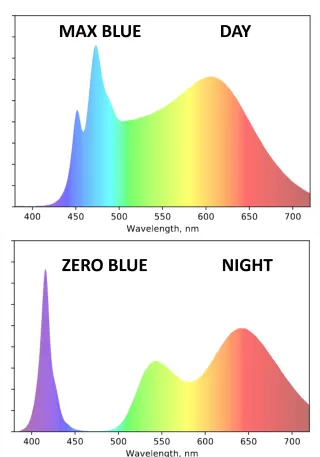
Human-centric lighting strategies respond by modulating colour temperature and intensity throughout the day. Cooler, blue-enriched light is delivered earlier when alertness is beneficial, while warmer light with reduced blue content is introduced later to support natural physiological transitions.
When combined with intelligent lighting controls, this approach aligns blue light exposure more closely with natural daylight patterns supporting both daytime performance and long-term wellbeing.
How zencontrol Enables Human-Centric and Blue-Light-Aware Lighting
zencontrol provides the control intelligence required to deliver these strategies effectively and at scale across commercial buildings.
Dynamic Circadian Lighting Profiles
zencontrol enables tunable white lighting to follow circadian-aligned profiles that automatically adjust colour temperature and intensity throughout the day. These profiles can be customised by space type, occupancy pattern, or operational requirement, ensuring blue light exposure is delivered intentionally rather than uniformly.
Sensor-Driven Responsiveness
Integrated occupancy and light-level sensors allow lighting to respond to real-world conditions ensuring human-centric and blue-light-aware strategies remain relevant as spaces are used, not just as they were designed.
Visibility, Monitoring, and Optimisation
Through cloud-based monitoring, facilities teams can verify that lighting strategies are operating as intended and refine settings over time. This enables continuous optimisation of comfort, wellbeing, and performance outcomes across the building lifecycle.
Beyond Compliance: A Strategic Advantage
Human-centric and wellness-driven lighting delivers value well beyond compliance or energy reduction. Organisations adopting these strategies are increasingly seeing benefits such as:
- Improved productivity and reduced fatigue
- Enhanced occupant satisfaction and workplace experience
- Stronger alignment with wellbeing and ESG objectives
- More attractive, future-ready commercial assets
In an environment where experience, health, and adaptability are key differentiators, lighting control has become a strategic investment, not just a technical specification.
Looking Ahead
As commercial buildings evolve in 2026 and beyond, the question is no longer whether lighting should support human wellbeing but how effectively it can be managed over time.
By combining tunable white technology, intelligent control, and data-driven optimisation, zencontrol enables lighting strategies that respect human biology, enhance visual performance, and deliver long-term value for both occupants and building owners.